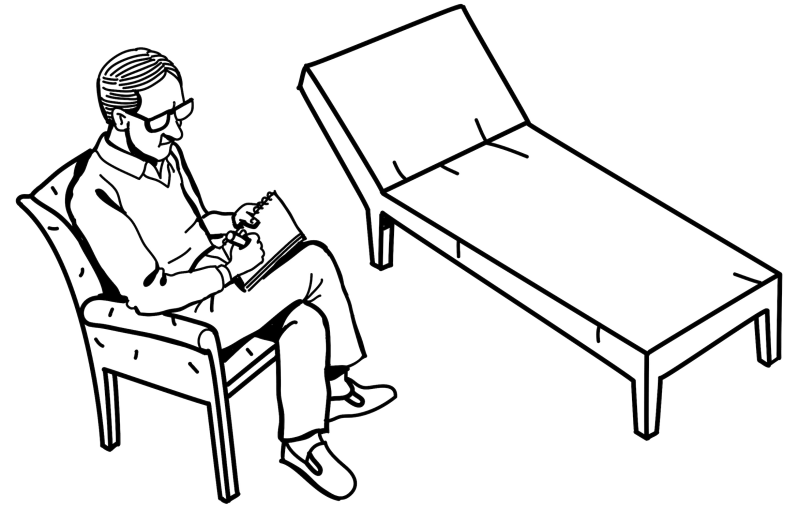
In the 19th century and at the turn of the 20th century our understandings of the human mind and the clinical potentialities took a leap. Since then, we have gained variety of new insights through clinical experience, speculation, case studies, debates, and research into psychological health and mental disorders. Where do I as a psychoanalyst fit in the clinical spectrum of contemporary psychology and psychiatry?
When I wrote this I sat at a coffee shop. Next to me sat two young psychologists who were in a heated discussion about clinical assessment and treatment options. Somehow, so it happened, that I became a part of the conversation. They were at the same time surprised, sceptical and thrilled to meet a psychoanalysts. I asked what they would like to know about psychoanalysis. They said: How are psychoanalysts trained? How is success measured? What interventions are uses? How do you choose your interventions? What follows is based on my initial answer to their question and on my reflections after the conversation had ended. The answers gives and overview of my clinical approach as a psychoanalyst.
A. Assessment, coaching and positive encouragement
As a modern clinical psychoanalysts I have an in-depth knowledge developmental psychology and the current knowledge frontier of the cause, development, and cure of psychological and mental disturbances. I am both well versed in the psychological theory and treatments, and skilled in creating, maintaining, and making use of the analytical situation as a curative endeavour. In all my clinical work I maintain enlightened empirical orientation even though I may also be sagely speculative and playful. I see my clinical work as a therapist-client collaboration and with my client I keep a keen eye on progression and appropriate outcome. My approach can either being oriented (non-active) and doing (active) oriented. In the latter the treatment focuses on the linkage between environment-behavior, the current situation, and time bound objectives.
If I were, beyond obvious manifestations in the reports and behaviors and functions of my clients, to measure the success (or lack thereof), of my treatments, then they should be measured like the success of all psychological treatments against a set of clear set of success criteria. Psychoanalysts have a variety of treatment interventions at their disposal (See, for instance, Psychodynamic Intervention Rating Scale (PIRS), Modified Multidimensional Classification of Psychotherapeutic Interventions (CMIP-M) and Meta-theoretical List of Therapeutic Interventions (MULTI)). Prudent psychoanalytical treatment is an enlightened improvisation where the analyst responds to the client with integrity and on strict moral ground with both general and specific techniques as to assess variations of the known and unknown psychological realties and dynamics that undermine client´s health. In my mind, psychoanalysis proper has at its disposal clinical intervention that are unique and have not been superseded.
I see my clinical treatment a cooperative process that entails a detailed—one-on-one or in a group—examination of the complex phenomena that is human subjectivity and its implications on affect, cognition, behaviour, and outlook on life. I offer clinical options that can be defined as as progression from simple initial short-time encounters where my client is dealing with relatively healthy condition to a more schematic clinical interferences to more radical in-dept explorations and inner journeys.
Assessment, existential consideration (Known Knowns). In the initial assessment, the analyst can use variety of rapport building methods, diagnostic tools, coaching and positive encouragement. Initially the analyst explores what night be going in a non-structured, semi-structured, or diagnostically structured interview, depending on the mental state of the patient, motive, and the urgency of the situation. In serious cases the analyst refers the client to a mental clinic that has resources to manage the severity of the situation. The analyst is also committed to make appropriate referrals if they are more fitted. Here the analyst also aims to establish a therapeutic alliance.
(B) Behavioural considerations (Unknown Knowns) where focus is on manifested maladaptive behaviour and the analyst can deploy variety of behavioural modification techniques. In the behavioral realm my extensive experience in working with children and exposure in management consulting and engineering pays off. I may use behavioral interventions (that are more general than specific) with clients in need of behavioral modification. Here I refrain from searching for internal causes and focus rather on the manifested overt (or covert) learned behaviour (i.e. thoughts, emotions, physiological) as a response to context (behavior assessment, mapping and modelling, for instance, based on Antecedent-Behavior-Consequence (ABC) models). Based on the clients level of motivation to change behavior I may use interventions based on identifying operants (neutral, reinforces, punishers) and modifying behavior through classical conditioning where involuntary response and a stimulus are associated (reciprocal inhibition, aversion, “negative“ practice, flooding, exposure and systematic desensitization) or operant conditioning where voluntary behavior and its consequence is associated (compliments, approval, encouragement, affirmation, change in environment, successive approximation through contingency (consequence) management, behavior mapping and modelling, token economy and/or social learning).
(C) Cognitive interventions (initial) (Known Unknowns) where the analyst explores cognitive schema and challenges irrational beliefs through variety of interventions. In the cognitive realm my background in philosophy and philosophical logic comes in handy. My cognitive interventions (that are more general than specific) aim at enhance cognitive and social functioning by helping my client to establish and maintain a constructive inner self-talk. I aim support my client in clarifying and change maladaptive expectations, beliefs, and attitudes towards his/her/hir problems. In an engaging and goal-oriented fashion we work together as to: Identify the problem, define its specifics (what, how, when, etc.), explore solutions, develop a plan to solve the problem, evaluate different strategies for implementing the plan, discuss the consequences of implementing the plan, and discussing alternative plans, agree on a course of action, and follow up. On the way I may use interventions such as verbal self-regulation, cognitive restructuring, activity scheduling, mindful meditation, reframing techniques, problem solving, and graded exposure. I may also challenge misconceptions, successive approximation models (SAM), use cognitive appraisal and methods to enhance sense of self-control and/or suggest assortment of coping strategies. I may also use interventions based on, acceptance and commitment (ACT), Socratic dialog, dialectics (BDT), motivational interviewing (MI), functional analytical psychotherapy (FAP), and existential psychotherapy and insights based on theories on language and cognition. I may also the interventions of mediation (letting-go-of thought and perception, mindfulness, concentration, absorption, Experience Analysis Technique (EAT), Phenomenology of Consciousness Inventory (PCI). I may also use hypnotherapy (traditional/directive hypnosis, permissive hypnosis, client-oriented conversational hypnosis, induction, relaxation, guided attention (handshake, levitation, eye cues, visualization, sudden shack, eye fixation, countdown, body scan), suppression of competing thoughts/stimuli, hypnotic suggestions (direct/indirect, interspersal metaphors, comparing/contrasting, reframing, flash, anchoring). I do not use hypnosis as to facilitate regression into past experiences/memories.
Psychoanalytical interventions (unknown unknowns). If the schematic methods of A+B+C are not viable treatment options, then I might suggest with my clients that we lower the plough and the cavernous treatment interventions of psychoanalysis considered. Psychoanalysis aims at gently unmasking troubling mental aspects that the client tries to mask with behaviours, cognitive means, defence mechanisms, and/or character traits. As an analyst I try to maintain compassionate analytic neutrality as not to take part in internal struggles of the patient. Even though the treatment can be regressive (revisiting the psychological past) the focus is always on the present, on the here-and-now manifestations as they surfaced in our interactions. The interventions I might use can, for instance, be exploratory interventions (free association, anamnesis, biographical exploration), empathy based interventions (anticipation, repetition, synthesis, phatic order, acquiescence, and support), explanatory interventions (explanation and meta-interventions), and what is in dynamic psychology called interpretation proper. Interpretation proper aims at sparking a shift, can be a dynamic interpretation (links defence to an affect), genetic interpretation (impact of past event on the present), and interpretation of resistance (avoiding of problems and therapeutic engagement), transference interpretations (old conflicts in current relationships, including with the analyst) and interpretation of contents of fantasies and dreams (relevance for current situation). Indicative interventions can be in the form of suggestion or advice, instructions, examination, and/or confrontation.
I may also deploy variety of other psychodynamic interventions such as involving people outside the analytical dyad, play, sand-tray, drama, and art therapy. In case of low ego functioning my approach is more supportive and compassionate. With people with issues related to early childhood deprivation, bonding, and attachment I may lean towards object-relational interventions (assessment, neutrality (being O), trust building, holding, identification of inner “objects”, projective/introjective allowances, projective identification, differentiation, practicing, rapprochement, aiming at object constancy. With clients with malfunctioning personalities, I may lean towards self-psychological interventions such as deep accurate empathy, understanding, and explaining regarding self-management I may support the client’s understanding in the developmental interconnection between self and environment (nonverbal emotional reciprocity, separation-individuation processes, socio-cultural influences) as to be able to creatively respond to it rather than passively react to it. With issues related to self-image and self-esteem I may use the interventions of supportive psychology such as deep empathy, mapping of self-objects, as well as transference of mirroring, idealizing and twinship with the aim to foster as secure and resilient sense of self.
Analytical psychology. In the realm of analytical depth psychology my background in religion, theology and cultural studies is essential. With creative people and people who are ready, willing, and capable to delve deeper into the unknown I may rely on interventions Jungian analytical psychology such as shadow work, exploration of the personal unconsciousness, the objective psyche, collective unconsciousness, complexes and archetypes, through active imagination, amplification, interpretations of images, symbols and dreams, analysis of transference and countertransference. we might also explore synchronicities (the psychoid dimension), transcendence function, typology and participation mystique, and “alchemical” processes and progression.
In all cases the client is encouraged to excavate the past as to alter the future and pursue personal integration in the here-and-now of the analytical situation, and then extent that integrity into the wider community.
The outcome of my psychological treatments range from turning hysterical misery into common unhappiness to total rejuvenation and deeper appreciation of self and others.
 Haukur Ingi Jonasson